

In our last post, we talked about what it means to be in change: what’s happening in your body, your relationships, and your sense of self when you’re moving through a transition. We talked about the gap, and how noticing it is actually a sign that you are growing.
But knowing that doesn’t always make it easier to be in it.
One of the things that makes organizational change particularly hard is that it’s happening to a group of people at once and those people are rarely in the same place at the same time. One person is still in shock while another is experiencing resistance. Someone is grieving what was, while someone else is energized by what’s coming. And all of them are trying to work together, make decisions together, and hold the organization together while navigating their own interior experience of the transition.
Understanding the emotional terrain of change is what makes it possible to lead through it without losing people along the way.
What follows is a framework we use in our work with organizations. It’s not a perfect linear progression. People move through these stages at different speeds, in different orders, and sometimes cycle back. But naming the stages, and the emotional responses that accompany them, is often the first step toward being able to work with what’s actually happening rather than just reacting to it.
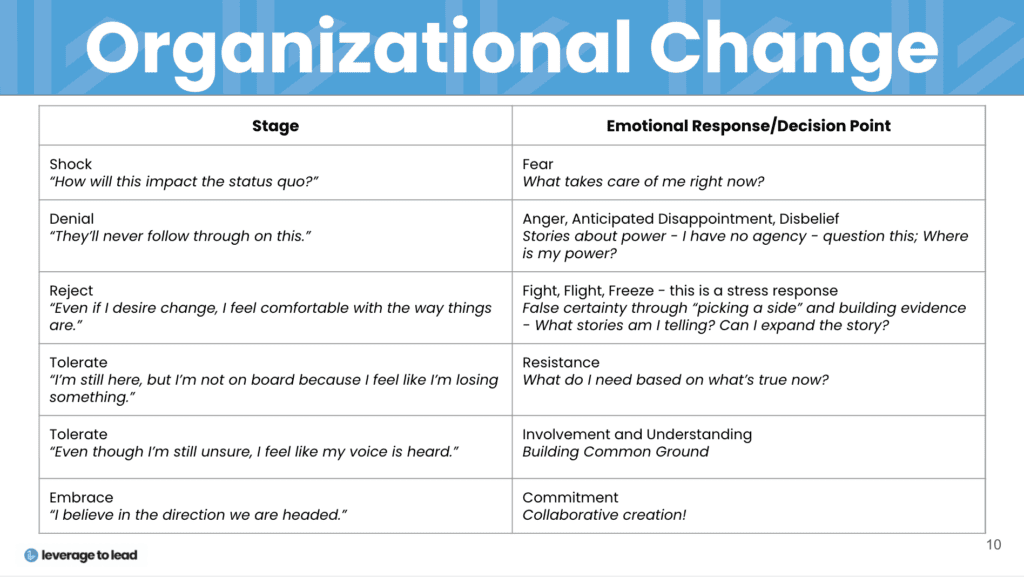
Shock
The announcement has been made. Something is shifting and you don’t yet know what it means for you. Everything feels slightly off-balance, even things that haven’t technically changed yet. The immediate instinct is to assess: how does this affect me? How does this change what I thought I knew?
This stage can look like stillness from the outside. But inside, there’s a lot of rapid processing happening.
What you might be feeling: Fear, disorientation, hypervigilance.
Questions worth asking: What do I actually need right now to take care of myself? What questions do I have about this change? What do I need to know?
Denial
Once the initial shock settles, a common next move is to minimize. They’ll never actually follow through on this. It won’t be as big a deal as they’re making it seem. Things will probably go back to the way they were.
Denial is protective. It gives the nervous system a moment to catch up. But when it persists, it becomes a barrier to getting accurate information, to making good decisions, and to engaging with what’s actually true.
What you might be feeling: Anger, anticipated disappointment, disbelief or even excitement.
Questions worth asking: What is actually true right now? If I’m not sure, how can I find out more information rather than filling in the gaps with assumptions?
Reject
This is where the stakes feel high. Even if part of you understands why the change is happening (and part of you may even want it!), the comfort of the familiar is pulling hard in the other direction. The known, even when it’s imperfect, feels safer than the unknown.
This stage often shows up as picking a side. False certainty can feel like solid ground when everything else is shifting. Fight, flight, and freeze are all possible here, sometimes on the same day.
What you might be feeling: Resistance, defensiveness, the urge to dig your heels in.
Questions worth asking: What stories am I telling myself about what’s happening and how much of that is actually true? How do I hold the feelings without feeling a need to immediately act upon them?
Tolerate (Part One): I’m Still Here, But I’m Not On Board Because I Feel Like I’m Losing Something
Something has shifted slightly. You haven’t left, but you’re not fully present either. There’s a sense of loss underneath the surface. Something that was familiar is going away. You’re grieving it, even if you don’t have language for that yet.
This stage can look like compliance without commitment. People are showing up, doing the work, but holding something back.
What you might be feeling: Resistance, grief, a sense of losing something you can’t quite name, unearned trust.
Questions worth asking: What do I actually need, based on what’s true right now? What is good enough that allows me to stay engaged? Where can I find common ground?
Tolerate (Part Two): I’m Unsure, But I Feel Heard
Your relationship to the change is evolving. You’ve been involved in some way. Your voice has been part of the conversation. You’re still not fully on board, but you feel less like something is being done to you and more like you’re part of figuring it out.
This is a critical threshold. It’s where people begin to move from enduring change to participating in it.
What you might be feeling: Cautious openness, grief for what was, the beginning of investment.
What makes this possible: Being genuinely included. Not just informed, but consulted. Having your concerns heard without them being immediately resolved or dismissed. This is where leaders who make space for professional grief, acknowledging that something real is being lost even as something new is being built, make an enormous difference.
Embrace
You genuinely believe in this new direction. You can see where this is going and you want to be part of getting there.
This is where energy shifts from endurance to investment. From surviving the change to helping build what comes next.
What you might be feeling: Commitment, creative energy, a sense of possibility.
What this makes possible: Collaborative creation. This is the kind of momentum that comes when people are building something together rather than just implementing something handed down.
A Note on the Arc
These stages are not a straight line. People cycle back. Someone who has reached embrace can move back to reject when a new piece of information lands badly, or when they feel like their voice has stopped being heard. Someone in denial can leap forward when they feel genuinely included in the process.
What matters is not moving people through the stages as quickly as possible. What matters is knowing where people are, so you can meet them there.
Leaders who understand this framework don’t just manage change, they steward it. They know that resistance is information. That grief is a sign that something mattered. That the goal is genuine commitment, and that commitment cannot be rushed or mandated. It has to be earned through presence, honesty, and the willingness to stay in the conversation even when it’s hard.
In our next post, we’ll look at what it means to steward change from the embrace stage. We’ll examine how leaders create structures and stability that help others move through their own arc, and what it looks like to build something new without leaving people behind.