
The Leadership Journey
We start with leaders.
Change starts with the leaders. Full stop. Period.
At Leverage to Lead, we define leadership as the practice of becoming a trustworthy steward of power—someone who holds responsibility with clarity and care and expands what’s possible within human-centered systems.
Why Leadership Development Matters
We’re calling on leaders to become trustworthy stewards: people who hold power responsibly, build and maintain trust, and lead change with integrity. An organization’s cultural health depends on this, fiscally, systemically, and experientially.
For leaders who care about the humans on their team, there’s often a gap between how they want to lead and how they’ve been trained, or not trained, to lead. Some leaders distance themselves from their own power, afraid of becoming “that kind of boss.” Often they’re self-sacrificing too, taking on too much to protect their team, and growing frustrated when it doesn’t get them the results they’re after.
Trustworthy leadership begins with human intelligence: a blend of relational intelligence and critical thinking that lets leaders shift their focus from doing to setting direction.
Rethinking the Leadership Ratio
Most leaders have been taught to lead by doing. Endless meetings, urgent decisions, full calendars. Leadership becomes about action.
Human-centered leadership asks us to rebalance how we lead. Instead of 80% doing and 20% thinking, we teach a 20/30/50 balance:
- 50% Critical Thinking: pausing, discerning, and making decisions grounded in values that prioritize humanity alongside profitability.
- 30% Relationship-Building: using Human-Centered Practices like deep listening, holding power responsibly, and emotional awareness to build and sustain trust.
- 20% Doing: translating clarity into aligned action, using tools like AI to create efficiency and free up time for relationship-building and critical thinking.
Leadership isn’t simply a role with more responsibility or more doing. It’s a practice of reflection, relationship, and integrity. When leaders do the inner work and develop systemic awareness, they gain the clarity and connection that strengthen teams, sustain trust, and make humanity their greatest leadership advantage.
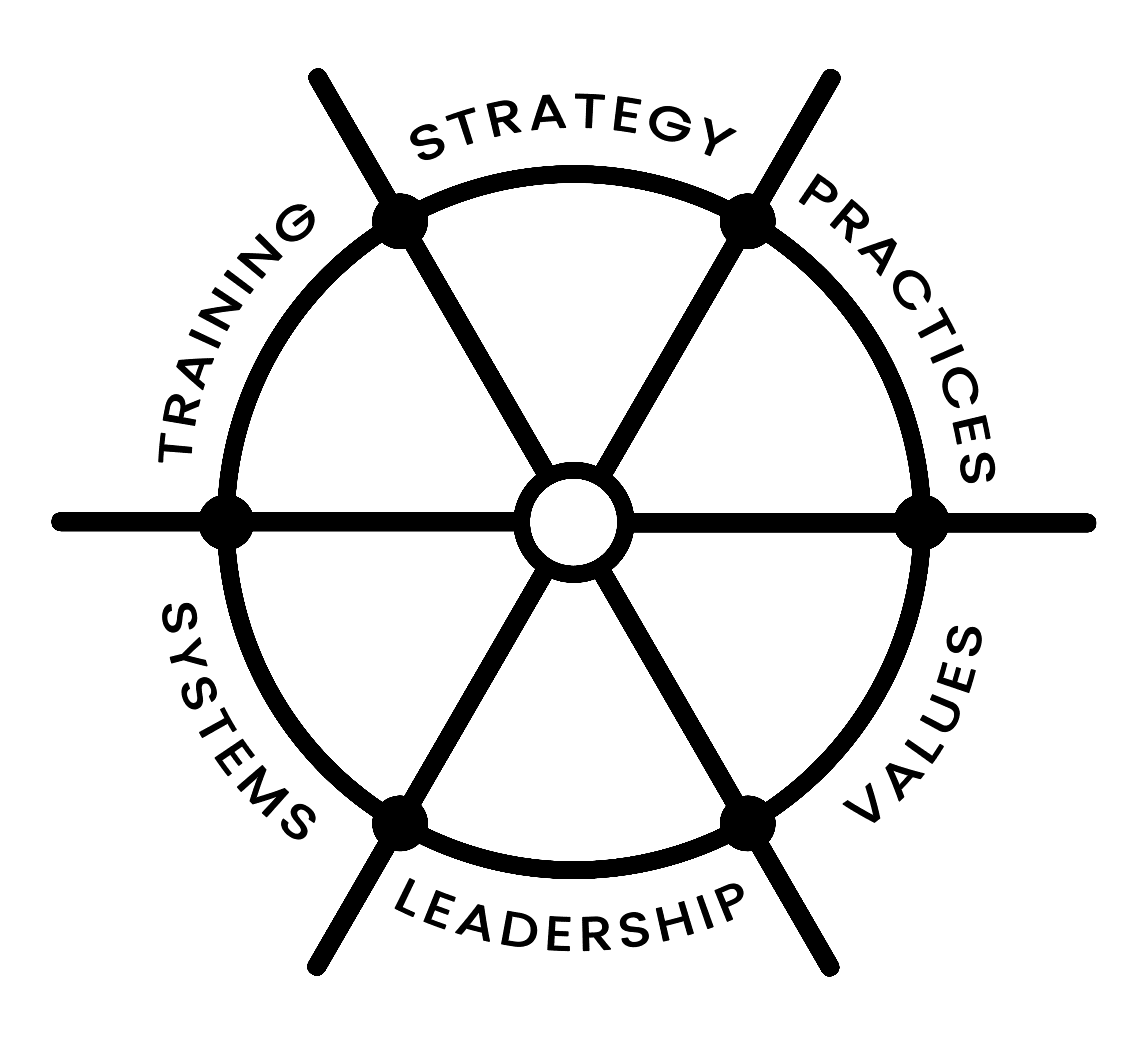
The Leadership Journey
This is the arc most leaders move through as they do this work with us. It’s not a straight line. It’s a practice.
Most leaders start not by knowing what to change, but by beginning to notice. In Stage 1: Recognition and Awareness, the work is about seeing the systems you operate within and understanding how they’ve shaped your experience, your opportunities, and your constraints. This is not about blame, but about curiosity.
The shift here is subtle but significant: it’s not just me, it’s the system.
◊
Stage 2: Reflection and Insight is where personal responsibility and systemic awareness start to coexist. You begin to see your own patterns, assumptions, and strengths with more clarity. It’s a time to develop your emotional literacy.
You start naming the dynamics at play rather than simply reacting to them.
◊
Stage 3: Practice and Alignment is where you start to put this awareness into action. You begin making decisions anchored in your values, testing what alignment actually looks like in the middle of a hard conversation, a high-stakes meeting, or an unexpected challenge. This stage is about experimentation and accountability.
You’re not trying to be perfect, just consistent and intentional.
◊
By Stage 4: Integration and Embodiment, leadership begins to feel less like effort and more like integrity. You trust yourself. Others experience your clarity without you having to explain it. Uncertainty feels less destabilizing.
This is where the work starts to become who you are.
◊
Stage 5: Expansion and Power is what integrated leadership makes possible. Leaders at this stage turn their attention outward, redesigning systems so that responsibility is shared, cultures can shift, and leadership doesn’t depend on any single person.
Power becomes collective.
Meet Your Coaches



Founder & CEO of Leverage to Lead
Managing Director of Learning & Development
Chief Human Resources & Impact Officer
Jennifer’s coaching presence is grounded and strategic. She draws on 16 years of law firm leadership across HR, finance, recruitment, and business strategy, and served as faculty at Smith College Executive Education. Her work with executives centers on challenging over-responsibility by operationalizing values: moving from intention to practice, from aspiration to action.
As a strategist, Jennifer works at the intersection of systems and self—helping senior leaders understand how their personal patterns show up in organizational dynamics, and how to lead with greater clarity, courage, and accountability. She is a trusted advisor who offers a candid perspective that builds agency and stays present through complexity.
MJ brings over two decades of experience as a teacher, manager, and facilitator, with deep expertise in adult learning, professional development, and organizational development. She holds an MA in Education and brings a relational, reflective approach that creates genuine psychological safety.
As a coach, MJ works with leaders at the level of identity and relationship. Her coaching creates space for leaders to examine how their beliefs and experiences shape how they show up, how they hold power, and how they build trust. She is particularly skilled at helping leaders who are navigating change, processing difficult feedback, or working to disrupt patterns that are no longer serving them or their teams.
Kim brings comprehensive HR expertise spanning operations, employee relations, talent management, compliance, and organizational systems design. Her work is characterized by a commitment to equity in practice, and she has deep experience developing human centered HR infrastructure that reflects organizational values alongside policy and compliance.
As a coach and consultant, Kim brings an HR practitioner’s lens to leadership development. She helps leaders understand how policies, structures, and practices shape employee experience, and supports them in developing the HR fluency to lead confidently through complex people situations.
“I loved one-on-one sessions with MJ. We started every conversation acknowledging that this is long-term work and that we wouldn’t solve everything in one session. But by the end of the hour, she had taken some very complex issues and helped me move forward.
She challenged me to see where I did and didn’t have the power to make a change, and to be vulnerable in expressing what I need. Going forward, I plan to be an example of what I’ve learned, to be the change myself, and to share with others that if you see the human side first, we can do great work together.”
Monthly Mentoring
At Leverage to Lead, we structure our coaching on a month-to-month basis. This gives leaders the flexibility to work consistently as we accomplish their goals and to push pause when they need time to integrate the learning.
As partners in achieving your goals, each month you will receive the support, ideas, and strategies to make informed decisions that align with your objectives.
We will cultivate and implement the strategy, practices, and habits that move your leadership forward. We start with an introductory session and then each month, clients will receive the following support:
- Introductory Strategy Session: A 60-minute session to clarify your goals, challenges, and vision for the future.
- Actionable Leadership Tools and Strategies: You will gain concrete tools and methodologies to navigate your most complex challenges. These include strategies for values-driven decision-making, conflict resolution, and building human-centered workplaces.
- Bi-weekly Coaching Sessions: Two 60-minute sessions per month, focused on career clarity, leadership narrative, and actionable strategies.
- Leadership Workbook: A companion resource with exercises, prompts, and tools to guide your reflection and track progress.
- On-Demand Support: Additional coaching calls available when urgent decisions or unexpected opportunities arise.